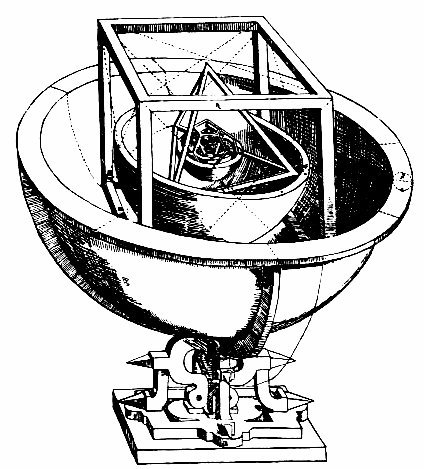
Copernicus and Kepler broke centuries of assumed science by disproving geocentricism and promoted their own heliocentric views. Copernicus introduced and shocked the medieval world by claiming that the earth was not the center of the universe. Kepler progressed this concept by claiming that there was not a "mover of the planets" but rather a force (perhaps his conception of gravity) that moved the planets and caused rotations.
The Bill of Rights assumes that the monarch will be Anglican, and forbids the persecution of Protestants as the catholic James I did. While the Bill of Rights didn't permit such a liberal anachronistic understanding of freedom of speech as we have in America today, it did advance quite radically in its break from monarchical tradition. The Bill of Rights permitted freedom of speech within a parliamentary setting. This parliament also aided the process of lawcraft. The king could no longer create new laws or taxes without the meeting of parliament and their full consent.
The Bill of Rights also notes how James (assumably the II) "abdicated" England. When Mary married William of Orange, and he came over from the Netherlands, James II fled England. However, the reference of James II's abdication may be in reference to his misuse of theology and throne.
This depiction by the Spanish Diego Valázquez of the Surrender of Breda demonstrates several different ideals about the Thirty Years War that perhaps correlated with his own perspective. Firstly, this depictions shows absolutely no violence whatsoever. We know from numerous other accounts that the Thirty Years War was quite a blood bath. Also, he depicts the humiliating submission of the Dutch to the powerful (and perhaps even merciful) Spanish.
The second painting by the Flemish artists Jan Brueghel and Sebastien Vrancx depicts one of the battles among the many of the Thirty Years War. Probably more accurate to the general feeling behind the War than the previous painting, this depiction shows quite a degree of chaos and bloodshed. Also, the painters were able to interpret the vastness of the war through the landscape and sense of it "going off into the distance".
Aristotle outlines the seven parts of ideal Tragedy as he attempts to cut down even literary terms to their essential definitions. He outlines them according to what he considers the most important of them in order from greatest to least.
Plot, he states, is the most important of the elements of tragedy. He says that it must have a beginning, middle, and end for structure, with events leading into each other. It must be whole in action, having complete events, and "of a certain magnitude", meaning that it needs to have length and be universally significant. Also a plot can be simple or complex. Simple plots have a catastrophe, whereas complex plots also have a catastrophe in addition to a transversal.
Characters are the second most important. Characters should be morally good, be true to their type, character, and themselves. They should also necessary or probable as they relate to a logical response and they should possess some idealised traits. When one comes across the tragic hero, pity or fear should be evoked as a mode of pathos. The hero should also possess a tragic flaw (hamartia) that determines the fate of the character.
Third most important is the themes of the play. These should be able to be proved through the actions in the play and acts a thesis in the play.
Fourth is the syntax, vocabulary, and lingual presentation of the play.
Fifth is the song, melody or general musical presentation of the chorus in the play.
Sixth is the spectacle of the play, or the degree to which the play is presented and how it is visually done so.
The last part of the play includes a cleansing (katharsis) of the emotions produced by the tragic hero. In this part of the play, the presentation must relate these emotions back to the intention and message of the play.
The Faustian Bargain calls that one trades over his soul to the Devil for eternity in exchange for some earthly benefit. In the case of Faustus, this benefit was to achieve divine knowledge. The nature of this bargain is quite short-sighted as it requires one to give up eternity for a brief amount of earthly glorification. As Faustus comes to realise this when his allotted time comes to an end, he regrets the bargain he made but is unable to retract it.
Faustus's main motivation for this bargain involves pure earthly incentive. He desires to achieve knowledge outside the bounds of humanity. He therefore concludes to achieve this knowledge through the power of Lucifer, assuming God would not provide him the same gifts. He also sought for immortality, which he does achieve through his bargain with Lucifer, except it is eternal suffering.
The Dutch Golden Age was a time of political peace, financial affluence, and artistic innovation. During this time, artists especially were on the rise as Dutch nobility generously patronised their art. Generally Dutch artists are noted by their depictions of everyday life inspired by landscapes found in their own country. Unlike French artists at this time, Dutch artists accumulate a degree of wealth from their patrons' generosity. Rembrandt (1606-1682) brilliant uses dark colours and sepia overtones to portray a spectrum of emotions to present a message. In addition to this distinction, Rembrandt is famous for his use of impasto or the painting technique that has visible three-dimensional paint strokes made by dried globs of paint on the canvas.
When James VI of Scotland also became James I of England, the two countries were united whether either of them like it or not. However when it came to religion, James immediately dropped the traditional Presbyterianism of his Scottish origins and promoted Anglicanism as the national religion. As uncomfortable as Scottish Presbyterians became over this, James and his son Charles's made everything worst. Charles began on evoking "shipmoney" which served as a faux tax to raise funds against the Scottish themselves. Secondly, he imposed the Anglican Book of Common Prayer on all citizens of Scotland. This effortlessly was the last straw for the Scots who began rebelling against England and it's Parliament.