Showing posts with label epic. Show all posts

02 May, 2014

Close Encounters with Ugolino and the Bottom of Hell

Why do we find so much imagery of eating in Cantos XXXII through XXXIV?


Here, in the pit of hell, we find the worst of sinners. The others were even too righteous to coexist with these foul creatures, having committed acts of satanic value. Evil birthing such lifelessness that fire itself could not eternal nor momentarily consume, but only a frozen wasteland of still and upside-down monsters. The screams and cries of anguish cease, reason and speech are abandoned due to their uselessness.

This is where Dante comes upon the figure Count Ugolino. Ugolino describes himself italian nobility in Pisa. Ugolino was born a Ghibelline, but soon joined the Guelf party as a means of obtaining more political power in Pisa. However he was exiled in his first attempt and later joined with Ruggieri. Both planned to seize power in Pisa, but as soon as their plan began working, according to Ugolino, Ruggieri betrayed him, causing his imprisonment and death. Historically, Ugolino was known to have betrayed Ruggieri first, but failed in imprisoning him as Ugolino had been. In prison, along with both his children (and supposedly grandchildren as well), they were locked in and the key thrown into a river, leaving them to starve. Accounts speak of Ugolino cannibalising his children in order to extend his own life further.

When Dante first comes upon Ugolino, he finds the shade gnawing on the brain of another, both encased waist-up in ice. The other shade he feeds on Dante discovers to be his betrayer, Ruggieri. The cannibalism Dante witnesses not only accounts for that he commits in prison, but also speaks to his sins in his political career as well. Ugolino, used what political power he had to climb over other people, thriving off of their demise, much like the idea of cannibalism.

Cannibalism exists in the centre of hell as the most evil of sins in Dante's hierarchy due to cannibalism's application to all three of Dante's denominations of sins. Dante categorises sins into three distinct sets: sins of incontinence, sins of fraud, and sins of violence. Cannibalism is a sin of violence in that it involves the murder of an individual and/or the mutilation of their body. It also is a sin of fraud in that it takes something that should be living and admired as the image of God and distorts it into something as common as food. Finally, cannibalism falls under the category of incontinence in that it is an unnatural way of satiating something as common as hunger.


24 April, 2014

Close Encounters with Farinata (Canto X)


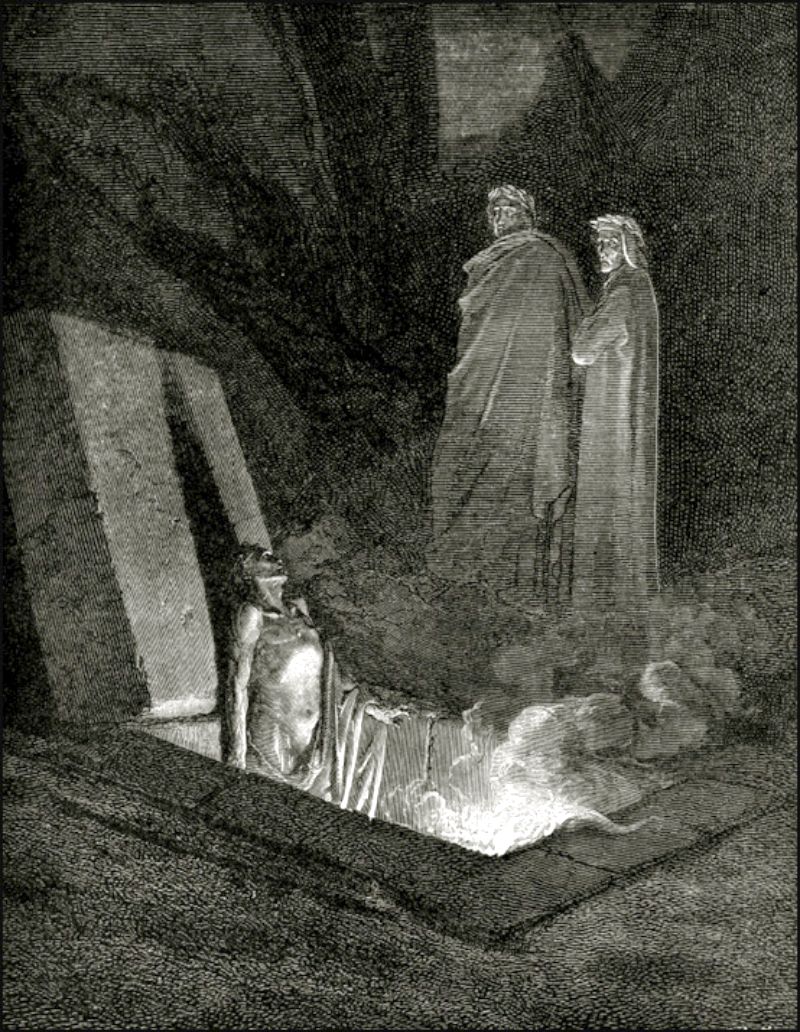
In Canto X of Inferno, Dante and Virgil still travel through the sixth circle of hell, where all heretics dwell. As the two walk through the graves intersecting their path, Dante pauses at one. Here, lies Dante's political enemy, Farinata degli Uberti, a ghibelline. The two figures recognise each other, but unfamiliar of what context, both present their ancestry. As soon as their backgrounds are established, tension arises between the two as they argue and defend their respective political parties.

This growingly tense argument is quickly interrupted by Cavalcante d'Cavalcanti, father of Dante's close friend, Guido Cavalcanti. He desperately asks Dante what became of Guido. Dante begins to respond, but hastily Cavalcante assumes Dante said that Guido died, and in pure desolation, descends back into his grave. The character introduces the righteous value of family in contrast to Farinata's value and obsession with political stature. 

Farinata and Dante continue their discussion. Even though the two political figures are enemies, they demonstrate a degree of respect for each other. Farinata and Dante have something in common, they both valued the city of Florence over their own political career. Farinata sacrificed his in order to salvage Florence from being "leveled", Dante refers to Farinata as "defender of Florence". However, both characters imply the irrelevance of Florentine politics in relation to their current position in hell.

Virgil summons Dante to continue on their journey.


10 April, 2014

Dante's Inferno Canto IV Summary


Canto IV begins with Dante and Virgil arriving on the other side of the River Acheron. Dante has officially arrived in hell. However, the place where he is, called Limbo, is the very outer edge of hell. As they arrive, Dante notes a loud chorus of wails and Virgil's face turn white with pity. Dante also takes on this state as he notes the inhabitants of Limbo and the source of the wailing. The souls they pass by are those of the unbaptised, infants, [righteous] pagans, and the ancient Hebrews. Dante sees a castle-like structure in which the righteous pagans dwell, among whom is Aristotle. Dante and Virgil speedily continue their way through Limbo.

The first thing to strike me while reading this Canto is how similar Limbo is set almost exactly like the Elysian Fields in Book VI in Virgil's Aeneid.

Also, I find it interesting how Limbo is a place for the unbaptised, and the righteous pagans get an even more special place in Dante's hell. Limbo was an invention of the early Church fathers for the purpose of having a name for the resting place for the unbaptised infants and ancient Hebrews. Dante, however, adds the "virtuous pagans" among these. Dante reluctantly cannot place figures such as Aristotle and Virgil in heaven because they were not Christian. However, they did possess some degree of "holy" wisdom (as mentioned by Augustine), and especially Aristotle, considering his influence on the Church, itself. 


25 February, 2014

Dramatic Irony in the Song of Roland


The Song of Roland is filled with suspense, adventure, and excitement. No matter when the story is written, the Iliad by Homer and all the way to the modern gladitorial story of the Hunger Games, dramatic irony works fluently and flawlessly throughout literary history.

Dramatic irony is when the audience is well aware of the proceeding events in the story, or understands the context of the events, while the character is clueless. Even though each member of the audience is empowered with this knowledge, and in no way is vulnerable to being harmed by any events in the story, the audience still experiences a mimesis of the emotions the protagonist experiences in the story.

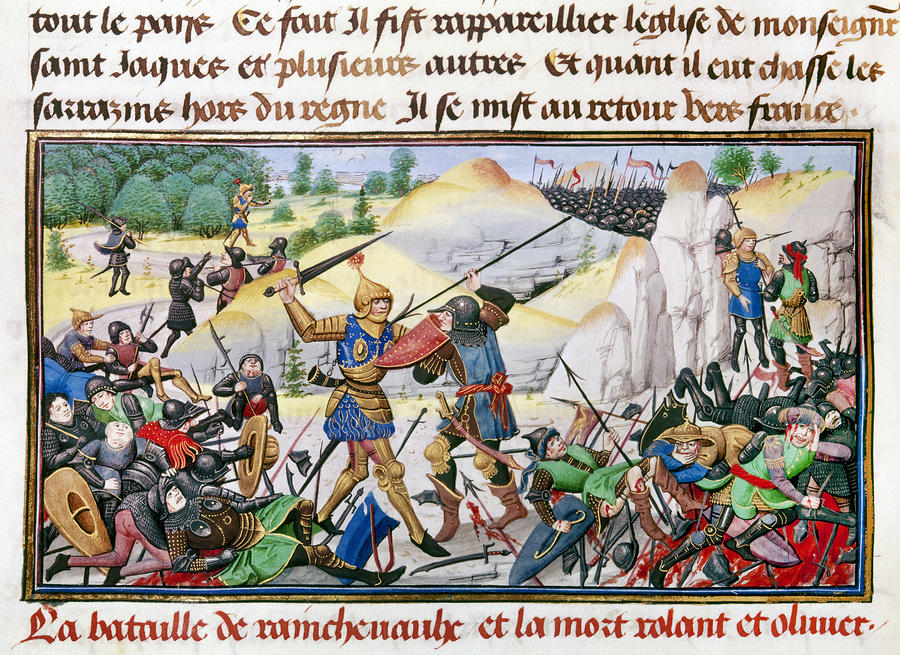
This mysterious literary technique is quite apparent in the Song of Roland, certainly in the battle sequences that appear in Laisses 91-130. In this section, we feel the awestruck fear Olivier experiences at the sight of the Paynim's forces. We experience the suspense in the battle as the French, as valiant as they are, cannot withstand the quantity of their enemies. And finally, we experience a sense of relief and loss as the Oliphant is sound for a retreat. Through all of this, we have been told by the author prior to these events, that Roland will lead the Franks in victory over the Paynims. Yet, we still experience the character's emotions as if we were in their own place. 

18 February, 2014

Heroism in the Song of Roland


In the Song of Roland, the poet makes a very sure distinction between not only the pagans and the Franks, but also between each of the individual characters. Through the heroes and villains in the story, the poet gives a moral expectation for the neo-Romans in Francia. The two heroes in the story, Charlemagne and Roland, symbolise heroism through their actions. Charlemagne, who is two centuries old and has gathered quite a lot of wisdom at this stage of his life, identifies with a more paternal figure and heroism. In the Song, Charlemagne is quite the opposite of the virile hero we might picture. Instead, he is a small, shriveled and ancient man, aged by life and the many battles he fights. He is wise, humble, and diplomatic. He symobolises one side of heroism in the Song.

Roland is depicted as a young fellow, well [self-] absorbed in his own youth. He is strong, noble, brave, and proud. He is the young virile hero we might imagine a medieval hero to be, and perhaps he was the one from which Charlemagne aged. While Roland lacks the wisdom and humility gained with age, he possess the physical prowess necessary in combat. And here lies the other side of heroism in the epic. However, it is important to note that without diplomacy, strength is useless; without humility, pride has no meaning; without wisdom, power is weakness. And so it is exemplified in the Song.

12 February, 2014

Summary of 'Guerre sainte dans La Chanson de Roland: La «Mythification» de l'histoire' as Translated by Mark Dominik


The Crusades is a tricky topic among Christians and non-Christians today. The sweet pious imagery of Christians we perceive from the medieval world completely mystifies the reason behind the horrific actions of the numerous Crusades. However, historians are well aware that these raids through the Holy Lands were by no means ignorant bursts of hatred. The Crusades were considered, by the Christians who participated in them, a Holy War. This was not merely a pillaging of Islamic land, this was a divine war, God-ordained, this was a way to establish your place in sainthood! The Song of Roland demonstrates to the general population of Francia that the act of murdering and pillaging through Arabia was not only justified, but proved their faith. Mark Dominik, in the essay he translates, notes the different literary elements of the Song that point toward a propaganda nature. 

Dominik identifies that the work is much aligned with a national epic, just as the Iliad was for the Greeks, and the Aeneid was for Rome.  The Franks of Francia are a newly established empire, or more correctly, a newly gathered tribes-people. Having witnessed the quality of power the Roman Empire had possessed over the known world, the Franks had a strong desire to be Rome, and through Clovis's conversion and Charlemagne's name, they were able to accomplish just this. While they now held the name, the Franks knew something was missing. The Rome they had seen had been overrun by Muslims. 
Here is justification number one: the Crusades are only taking back their own land; robbing the robbers; becoming Robin Hood for the Mediterranean. 

Not only do the Franks find a national identity within the Song, they are also able to mythologise religious and political leaders into epic heroes and small battles into great war triggers. The Song of Roland articulates the many atrocities that happened in the battle of Roncevaux at the hands of the evil Muslims, when in fact this was a short battle with the Basques. The heroes of this story end up being both the sacrificial Roland and the omnibenevolent Charlemagne. Dominik notes that both of these men take on the role of Christ symbolically in the Song, providing a tactile embodiment of Christ as a role model of the ideal Frankish Christian citizen, as Aeneas did in the Aeneid and Achilles in the Iliad. And here come the second justification: the Crusades are an act of justice for our fallen hero and serve as a way of imitating a morally upright Christian. 

Another element the author notes abundant throughout the Song is the mentality the poem develops. In the Song, the poet readily establishes an "us vs. them" mentality. The Song never establishes that the enemy they fight are specifically of the Islamic religion. Instead, much broader terms are used, such as pagans. This term not only includes Muslims, which the Crusades were primarily targeted at, but also any non-Christians. Charlemagne not only picked fights with Arabs, but also much further North with Saxons, also of a 'pagan' religion. In addition to this division, the Song clearly denotes the moral purity of themselves (the Christian) against the incurable immorality of the pagans (perhaps Saxons and Muslims). This immorality was seen to such a radical degree that the very language of the poem begins to dehumanise the enemy. Their view of morality remained very black and white. Since all Franks were Christians and all Christians were morally correct, all Franks were morally pure. And also since Christianity was the only way, all non-Christians (read pagans) were evil. Finally, here is the third justification: the Crusades served as a way of keeping the Mediterranean world pure from pagan (evil) contaminants (of a non-human source), and encouraging the world toward a Godly and upright moral standard.  

The complex and questionable nature of the Crusades was of the same nature even prior to the First Crusade. However, the justification of their actions, as demonstrated through Dominik's essay on the Song of Roland, shows a thorough moral compensation for the atrocities committed by the wandering Crusaders. Unfortunately, the propaganda of literary articles such as the Song worked in making the Crusades of a "Christian" source.