In this odd tale, Chaucer makes use of a folklore-esque tale about animals to speak truth about humans, much like Aesop's Fables.
Chanticleer is a rooster, one known for his beauty and crow. He is also quite a proud rooster, but perhaps he is deserving to be. He falls in love and eventually 'marries' (or whatever is the poultry equivalent) an equally beautiful hen named Pertelote. The two are happy and live on as such until one day when Chanticleer is disturbed by a dream in which he is attacked by an "orange beast". Pertelote tells him not to be troubled by it, assuming it to be a physical ailment. And so, the two live happily again.
Their happiness is again interrupted one fateful day. As Chanticleer is out once day in the yard, a fox comes by and spots Chanticleer. Initially alarmed, remembering his dream, Chanticleer begins to leave, but the fox promises no harm. The fox begins to sing to Chanticleer of his own great beauty. As he does so, Chanticleer closes his eyes and stretches his neck to further demonstrate his beauty. The fox quickly takes his opportunity and lunges at the rooster, grabbing the throat and leaping back into the woods from whence he came.
Pertelote begins grieving upon hearing the news, and quickly gathers a party to avenge her husband. A band of dogs go into the woods to find the fox running up a tree with the alive Chanticleer in his mouth. Chanticleer suggests that the fox flatters the dogs to save their lives, and as he opens his mouth to do so, Chanticleer flies out to another tree.
The fox, as a final attempt, begins flattering Chanticleer once again to get him to come back. Chanticleer declares that he has learned his lesson of humility and the deceptive nature of flattery.
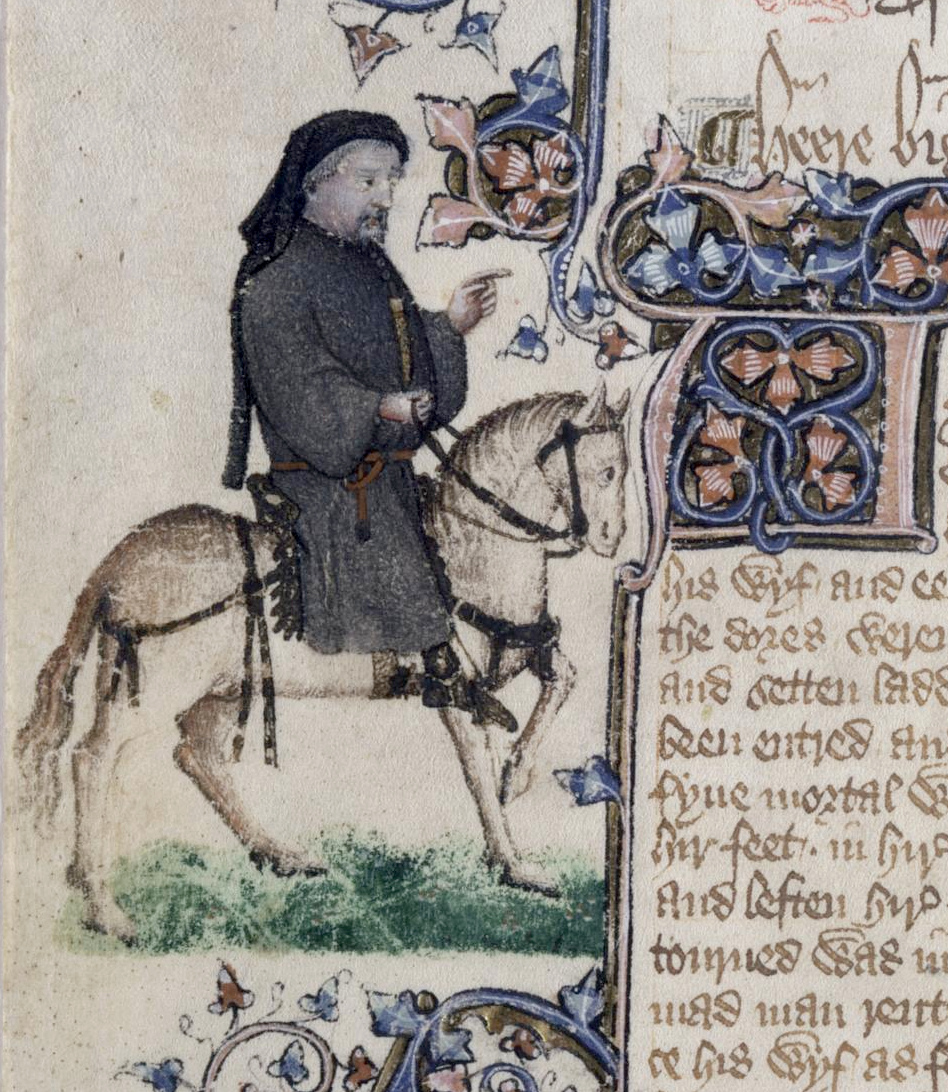
Geofferey Chaucer's Canterbury Tales serves as a complex poetic satire of the late-Medieval English society he lived in. In the general prologue, Chaucer introduces all of the characters in the rest of the tale, accounting for their poor character traits as lightly as possible. However two characters in particular give examples of how Chaucer does this, the Pardoner and the Oxford Cleric satirically represent two different types of people in Chaucer's society.
The Pardoner's position in the Church is to collect indulgences, that is money "donated" to the church to "forgive" sin. However, in Chaucer's presentation of the character shows him to be corrupt, greedy and guilty of simony. In his portrayal he accuses the Pardoner of being two-faced by saying, "he sew'd a holy relic on his cap; his wallet lay before him on his lap..." and also that "by his flatteries and prevarication made monkeys of the priest and congregation." Chaucer further makes vicious the Pardoner's character with the following lines:
"But best of all he sang an Offeratory,
For well he knew when that song was sung
He'd have to preach and tune his honey-tongue
And (well he could) win silver from the crowd.
That's why he sang so merrily and loud."
Simony and other misuses of ecclesiastical powers are major themes in Chaucer's work. Through the satirical illustrations of the Pardoner, the priests, the nun, the monk, the parson, and other characters, Chaucer makes [negative] political commentary on the issues of his time.
The Oxford Cleric is made fun of as well, but not to the degree of the Pardoner. The Cleric is said to "had found no preferment in the Church", indicating his lack of piety, but on the bright side, "he was too unworldly to make search for secular employment." And "whatever money from his friends he took he spent on learning or another book...", whereas the Pardoner took money from people for his own pleasure and in the Church's name.
Even though the Cleric may be just as "in-virtuous" as the Pardoner, I would argue that the Pardoner's sin is magnified greater due to it's ecclesiastical corruption. The comparison of these character's, and others, demonstrates Chaucer's dissatisfaction with the Church in his time.
Sir Gawain and the Green Knight, or as I will abbreviate for the sake of abbreviation, SGGK, begins by summarising the history of Britain, beginning as early as the beginnings of Rome from the Trojan War and Romulus. The poet writes of the great men of Britain, including King Arthur, whence the story of SGGK takes place: his court in Camelot around the Round Table.
After this background, the story begins at Christmastime in Camelot, where Arthur, Genevieve, and their court celebrate by feasting. A large mysterious man clad in green appears and asks someone to dual him. No one in the court accepts, and the green knight questions the fortitude of the knights of the Round Table. Arthur then accepts the dual, but when interrupted by his frail cousin, Gawain, who takes on the dual himself. The green knight demands that after the dual, Gawain must find him where he lives. Gawain accepts and the green knight exposes his neck as Gawain beheads him with an axe. The bleeding head of the green knight. The green knight's body walks to the head, picks it up, and reminds Gawain of their deal. With head in arm, the green knight rode off.
Arthur, unmoved by the odd events, continued the feasting and celebration in his court.
As far as meter goes in the story, I noticed that [roughly] every 20 lines, the poems flow would be broken by four lines of iambic hexameter. These four lines seemed to serve as transitional lines in the poem, moving the story from one event to another.
The Song of Roland is filled with suspense, adventure, and excitement. No matter when the story is written, the Iliad by Homer and all the way to the modern gladitorial story of the Hunger Games, dramatic irony works fluently and flawlessly throughout literary history.
Dramatic irony is when the audience is well aware of the proceeding events in the story, or understands the context of the events, while the character is clueless. Even though each member of the audience is empowered with this knowledge, and in no way is vulnerable to being harmed by any events in the story, the audience still experiences a mimesis of the emotions the protagonist experiences in the story.
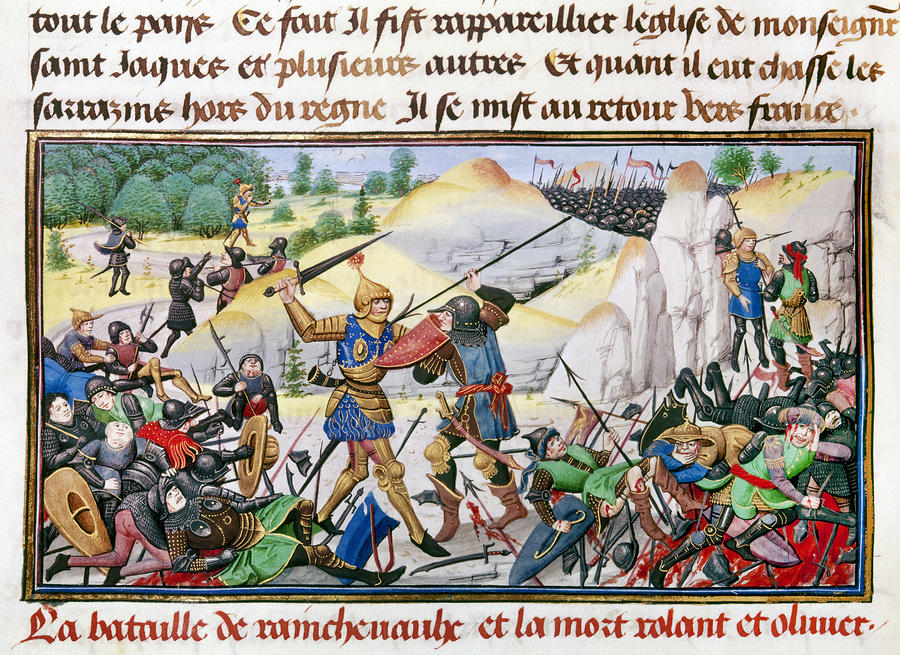
This mysterious literary technique is quite apparent in the Song of Roland, certainly in the battle sequences that appear in Laisses 91-130. In this section, we feel the awestruck fear Olivier experiences at the sight of the Paynim's forces. We experience the suspense in the battle as the French, as valiant as they are, cannot withstand the quantity of their enemies. And finally, we experience a sense of relief and loss as the Oliphant is sound for a retreat. Through all of this, we have been told by the author prior to these events, that Roland will lead the Franks in victory over the Paynims. Yet, we still experience the character's emotions as if we were in their own place.
In the Song of Roland, the poet makes a very sure distinction between not only the pagans and the Franks, but also between each of the individual characters. Through the heroes and villains in the story, the poet gives a moral expectation for the neo-Romans in Francia. The two heroes in the story, Charlemagne and Roland, symbolise heroism through their actions. Charlemagne, who is two centuries old and has gathered quite a lot of wisdom at this stage of his life, identifies with a more paternal figure and heroism. In the Song, Charlemagne is quite the opposite of the virile hero we might picture. Instead, he is a small, shriveled and ancient man, aged by life and the many battles he fights. He is wise, humble, and diplomatic. He symobolises one side of heroism in the Song.
Roland is depicted as a young fellow, well [self-] absorbed in his own youth. He is strong, noble, brave, and proud. He is the young virile hero we might imagine a medieval hero to be, and perhaps he was the one from which Charlemagne aged. While Roland lacks the wisdom and humility gained with age, he possess the physical prowess necessary in combat. And here lies the other side of heroism in the epic. However, it is important to note that without diplomacy, strength is useless; without humility, pride has no meaning; without wisdom, power is weakness. And so it is exemplified in the Song.
A typical night in the glory of an Arabian province. A wealthy turban-ed man comes home from a long day of work managing his local oil rig, producing millions upon millions of dollars each week. "Salem, Abdul!", cautiously says one of this seven wives. Yes, this man's name is indeed Abdul Muhammed Nassar. "Prepare me my falafel, woman!" he yells back sternly, and quite honestly, forgetting whether it was Fatima or Alia whom he addressed. At no more than this, the unknown wife runs back into her familiar place in the kitchen, fearing for her life, considering the fate of her predecessors. After all, Abdul has had a long day at work, his personal belly-dancer was ill today, and his cousin, Hakeem Muhammed Sarkis, had died in a local bombing (one which he himself initiated, of course), and at any point, her husband could act homicidally.
What must this do with Ali Baba and the Forty Thieves? In this apparently simple story, the under lying theme does its best to reject and discredit the many stereotypes the West has developed about the arab culture, most prominently, those regarding Arab women.
Marjana is the lowest of low. She is a slave. And not only is she a slave, be that bad enough, she is a female slave. She serves her master, Qasim, until he is murdered. She then helps dispose of the body by faking a post-mortem death. Be that not clever enough, she saves the life of her more heroic master, Ali Baba, on multiple accounts and continues to murder thirty-eight thieves. Her keen intellect and sharp wits are demonstrated throughout our story, emphasising the fact that this woman is only good befriended, or married to, as Ali Baba took to.
The cleverness of Marjana in Ali Baba and the Forty Thieves annihilates all and any remaining stereotypes about either slaves or women that were perpetuated by the readings of such misogynous stories such as the The Tale of Scheherazade. In that story, the only role women played was to destroy the lives of men, extracting the only meaningful moral which was to control your wives through any means, especially if it means physical beatings or execution. In contrast, Ali Baba and the Forty Thieves demonstrates women in a way that strongly benefits the house of Ali Baba Instead of chaos breaking when the woman deals in secrecy, Ali Baba life is spared multiple times, noting that women are much more beneficial in deception than in tight grips, another common stereotype of arab culture.
The Tale of Scheherazade is a fascinating story of two Arabian men defending their own status of manliness from the actions of their very own wives. Despite its quite simple plot and curious (especially to westerners) moral theme, this Tale of Scheherazade offers an abundance of commentary of the workings of Arabian literature in the culture it was being read.
One important element I noted in reading The Tale of Scheherazade was the emphasis put into the character descriptions and the conflicts between the characters. Interestingly, the sole source of conflicts in this story is adultery, a practice frowned down upon in many cultures, especially in Islamic Arabia. In many western stories, we see conflict between men and men, men and gods, and gods and gods. Here we have an instance of conflict between man and wife, familial bonds broken, never to be repaired. Family is an important part of all cultures, and serves a great plot twist when there are marital bonds betrayed. In Sophocles' Oresteia, family bonds are treated with just as much emphasis and are dramatised in similar degrees. As for character description, the story places heavy emphasis on the relationship of one's social status with their racial and aesthetic characteristics.
Another element that plays in the story is the immersion of religious and political law. In the story, when the wives and their lovers are caught in adultery, the natural response was capital punishment. Law appears unquestionable in this story, as the punishments dealt in the story are termed in such "matter-of-fact" words.
The last part of the narrative that I found interesting was its fairytale-esque mannerisms. The story is presented within another story. There is a mythical element to it that coordinates with the reality of the story. And most notably in Burton's translation, there is an almost "forced" rhythm and metre to it. Each of these parts reminds me of tales of Aesop and Grimm, while having the mature content and sophistry of Homer and Virgil.